
Desserts
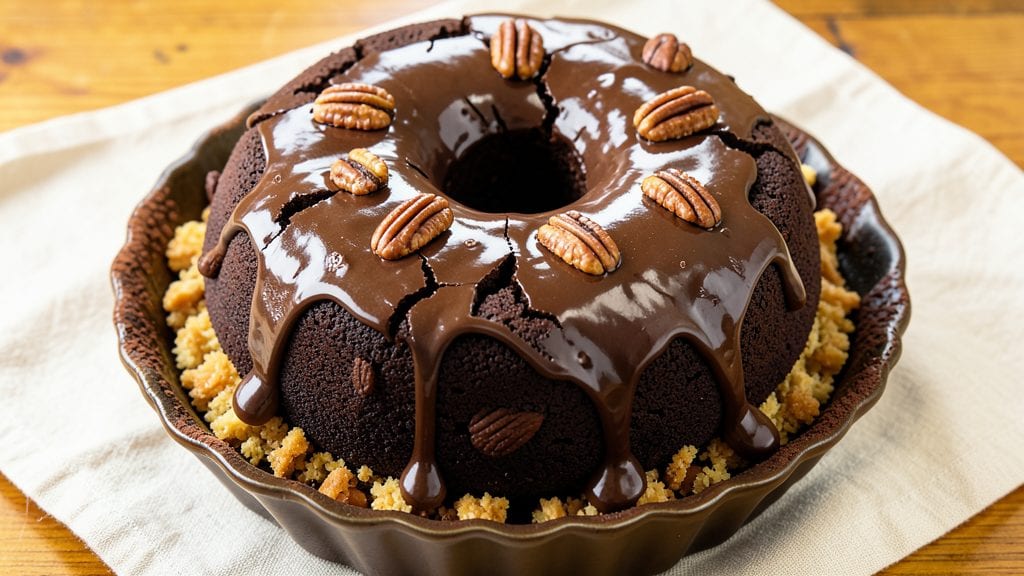
This old-fashioned German chocolate cake recipe delivers the rich, toasted coconut-pecan swirls that made German’s Bakery famous—without the dreaded separation or dry crumb. The secret lies in a precise balance of coffee-infused chocolate frosting, moist cake layers, and a swirl technique that keeps everything luscious.
I’ve perfected this version after years of testing, ensuring every slice stays tender and flavorful.
The cake’s signature German influence comes from the coffee notes in the frosting, a nod to the original recipe’s deep, slightly bitter chocolate base. Toasted coconut and pecans add texture and sweetness, while a simple swirl method (not folded) prevents that frustrating separation many home bakers encounter.
The result? A cake that’s moist, rich, and packed with those iconic swirls—just like the bakery version.
What sets this recipe apart is the foolproof method for achieving a perfectly moist crumb without greasing the pan excessively. The frosting, made with melted butter and coffee, stays velvety smooth while delivering that classic German chocolate depth.
Each layer is stacked with precision, ensuring every bite has that signature swirl of coconut and pecan.
This cake is ideal for celebrations, family gatherings, or when you crave a dessert with old-school charm. The instructions walk you through baking the layers, preparing the frosting, and assembling it like a pro. No shortcuts—just a guaranteed crowd-pleaser that tastes like nostalgia in every slice.
Ingredients for old fashioned german chocolate cake
Fifteen precise ingredients transform into German’s Bakery-style cake layers with signature swirls.
| Ingredient | Amount | Notes |
|---|---|---|
| All-Purpose Flour 🌾 | 3 ½ cups | Sifted for even texture |
| Unsalted Butter 🧈 | 2 cups | Cold, cubed for creaming |
| Granulated Sugar 🍚 | 2 ½ cups | Superfine preferred for smoothness |
| Dark Brown Sugar 🍚 | 1 ½ cups | Packed firmly for accuracy |
| Large Eggs 🥚 | 4 whole | Room temperature for even mixing |
| Baking Cocoa 🍫 | 1 cup | Dutch-processed for smoothness |
| Instant Espresso Powder ☕ | 2 tbsp | For authentic coffee depth |
| Baking Powder 🍞 | 1 tsp | Freshly measured for lift |
| Salt 🧂 | ½ tsp | Diamond Crystal preferred |
| Vanilla Extract 🌿 | 2 tsp | Pure Madagascar bourbon |
| Milk 🥛 | 1 cup | Whole milk for richness |
| Toasted Coconut Flakes 🥥 | 2 cups | Lightly toasted in dry pan |
| Chopped Pecans 🌰 | 2 cups | Toasted until fragrant |
| Semisweet Chocolate Chips 🍫 | 1 ½ cups | High-quality, 60% cocoa |
| Heavy Cream 🥛 | 1 ½ cups | Cold for stable whipping |
| Powdered Sugar 🍚 | 3 cups | Sifted for smooth frosting |
| Instant Espresso Powder ☕ | 1 tbsp | For frosting depth |
The flour and butter form the cake’s foundation—King Arthur flour yields the best crumb, while European-style butter like Plugrá delivers superior richness. For the cocoa, Valrhona Abinao or Ghirardelli ensure deep chocolate flavor without bitterness. Espresso powder should be freshly ground from beans (like Lavazza) for authentic coffee notes. Pecans and coconut must be toasted separately to prevent burning—lightly browned in a dry skillet until fragrant. Chocolate chips should be high-cocoa (60% or more) to avoid greasiness.
No espresso powder? Strong brewed coffee reduced by half works, but instant coffee granules at double the amount are the closest substitute. Butter substitutes like vegetable shortening can be used, but the texture suffers—European-style butter is non-negotiable for moisture. Toasted coconut can be replaced with unsweetened shredded coconut (toasted in the oven at 300°F for 10 minutes), though texture differs. Pecans can be omitted entirely if nut-free, but the chocolate chips should be increased to 2 cups for balance. Powdered sugar for frosting can be swapped for confectioners’ sugar (sifted thoroughly), but superfine sugar yields a smoother finish.
Store dry ingredients (flour, cocoa, sugars) in airtight containers for up to 6 months. Butter and eggs should be used within 2 days of opening. Toasted nuts and coconut lose crispness after 3 days—portion into single-serving bags for freshness. Frosting keeps for 5 days refrigerated or 3 months frozen. Assembled cake stays fresh for 4 days covered at room temperature or 1 month refrigerated. For long-term storage, freeze layers unfrosted for up to 6 months—thaw and frost just before serving.
Why You'll Love This Recipe
- One-Bowl Wonder: I swear by this recipe when I’m too tired to wash extra bowls. The butter, sugar, and eggs all go in first—no separate mixing required—and the flour just folds right in. That dark brown sugar? It dissolves like magic, leaving you with a smooth batter that practically mixes itself.
- Rich Without Effort: Between us, this cake tastes like a bakery’s secret. The brown sugar and butter create this deep, caramel-like depth, while the eggs keep it moist without tasting eggy. Honestly, it’s the kind of flavor that makes you pause mid-slice and go, “Wait, is this even homemade?”
- Party or Picnic: I’ve served this at birthday gatherings, potlucks, and even packed it for a hike (yes, really). It holds up perfectly for days, so you can bake it ahead and not stress. The texture stays tender, and the taste only gets better as the flavors meld—ideal for when you want dessert that’s as reliable as it is delicious.
- Budget-Friendly Luxury: This recipe uses pantry staples—no fancy ingredients or last-minute grocery runs. A stick of butter, a cup of sugar, and a handful of eggs stretch far, and the leftovers? They disappear faster than I can say “second slice.” Plus, it’s cheaper than buying a boxed mix that tastes half as good.
Step-by-step instructions for old fashioned German chocolate cake
This classic cake delivers rich chocolate layers with swirls of toasted coconut and pecan filling—no separation, no fuss.
Prepare the Dry and Wet Ingredients Separately
In a large bowl, whisk together the 3.5 cups all-purpose flour, 1 cup baking cocoa, 1 teaspoon baking powder, 0.5 teaspoon salt, and 2 tablespoons instant espresso powder. Sift the mixture twice through a fine-mesh sieve to aerate and remove any lumps. This ensures an even texture throughout the cake layers.
In a separate heatproof bowl, melt the 2 cups unsalted butter over a double boiler or in short bursts in the microwave. Once fully melted, whisk in the 2.5 cups granulated sugar, 1.5 cups dark brown sugar, and 2 teaspoons vanilla extract until the sugars dissolve completely. The mixture should be smooth and homogeneous—no graininess should remain.
Combine Wet and Dry Ingredients for the Cake Batter
With the melted butter mixture still warm, gradually add the 4 whole large eggs, one at a time, whisking vigorously after each addition. This step is critical—whisk for 30 seconds per egg to emulsify properly and prevent curdling. The batter should thicken slightly but remain pourable.
Alternate adding the sifted dry ingredients and 1 cup milk in three parts, beginning and ending with the dry mixture. Mix on low speed until just combined—overmixing develops gluten, which can make the cake dense. The final batter should be thick but smooth, with no visible flour streaks. Fold in the 1.5 cups semisweet chocolate chips by hand using a rubber spatula to distribute them evenly.
Create the Coconut-Pecan Filling
In a small saucepan, combine the 1.5 cups heavy cream and 1 tablespoon instant espresso powder. Bring to a gentle simmer over medium heat, then remove from heat and stir in 3 cups powdered sugar until fully dissolved. The mixture should thicken slightly into a glossy, pourable consistency—similar to heavy cream frosting.
In a separate bowl, mix the 2 cups toasted coconut flakes and 2 cups chopped pecans. Pour the warm cream mixture over the coconut-pecan mixture and stir until fully coated. Let the filling cool to room temperature before using—this prevents melting when incorporated into the cake layers.
Layer and Swirl the Cake
Preheat your oven to 350°F and grease three 9-inch round cake pans with butter or baking spray, then line the bottoms with parchment paper. Divide the cake batter evenly among the pans, spreading each layer smoothly with a spatula. Bake for 25-30 minutes, or until a toothpick inserted into the center emerges clean.
While the cakes cool in their pans for 10 minutes, spread a thin layer of the coconut-pecan filling onto the first cake layer. Place the second cake layer on top, then spread another thin layer of filling. Top with the final cake layer and gently press down. Use a long serrated knife to swirl the filling through the layers, creating marbled patterns. This technique ensures every bite contains both cake and filling.
Cool and Serve for Maximum Flavor
Transfer the assembled cake to a wire rack and let it cool completely at room temperature for at least 2 hours. This resting period allows the layers to set and the flavors to meld. The cake should be firm enough to slice cleanly without crumbling, with visible swirls of coconut and pecan throughout.
Slice into 12 equal wedges and serve at room temperature. The cake's texture should be moist yet tender, with a rich chocolate base and bursts of toasted coconut and pecan in every bite. For best results, store leftovers covered at room temperature for up to 3 days—the flavors deepen as it sits.
Pro Tips For Making Old Fashioned German Chocolate Cake
- Cream Butter Slowly: Don’t just toss in softened butter—beat it with the sugars at medium speed for 3-4 minutes until the mixture turns pale and fluffy. I used to rush this, and the cake ended up dense. That extra time lightens the texture, and it’s worth the wait.
- Sift the Flour Twice: German chocolate cake relies on a tender crumb, so skip the scooping and sift the flour before adding it to the batter. If you’re lazy (I know, I know), at least whisk it vigorously to break up clumps—otherwise, you’ll get a cake that’s more brick than dessert.
- Avoid Overmixing Eggs: Once you add the eggs, mix just until combined—no need to beat them into oblivion. Overworking them makes the cake tough, and trust me, you’ll taste the difference. Stop when the batter looks smooth, not when your arm starts to shake.
- Test for Doneness Early: This cake’s center should spring back slowly when pressed, but don’t wait for a toothpick to come out clean—it’s dense and will hold moisture. Pull it out when the edges pull away from the pan and the middle still jiggles slightly. Overbaking dries it out, and nobody wants that.
Regional styles of old fashioned german chocolate cake
German’s Bakery Roots
The original German chocolate cake traces back to Sam German, a baker who created a rich chocolate cake in the 1950s. His recipe featured cocoa, coffee, and pecans, inspired by German immigrants who brought baking traditions to America.
The cake became a Midwest classic, especially in Ohio and Indiana, where German’s Bakery still operates today. 🌟
Midwest Homestyle Twist
In Ohio and Indiana, this cake is often baked in 9x13-inch pans instead of layers, creating a dense, fudgy texture. Locals add extra pecans (up to 3 cups) and toast them with brown sugar for caramelized flavor.
The frosting sometimes includes Kahlúa or coffee liqueur for deeper richness. This version is served at state fairs and church potlucks as a symbol of comfort.
Southern Comfort Adaptation
Southern bakers lighten the cake by replacing some flour with cornmeal (about ½ cup), giving it a moist, slightly crumbly texture. They also fold in chopped walnuts alongside pecans and drizzle the top with hot fudge sauce before serving.
In Tennessee and Georgia, this variation is a staple at holiday gatherings, often paired with vanilla ice cream for a decadent dessert.
Modern Bakery Techniques
Today’s bakeries use high-ratio cake mixes (like Betty Crocker German Chocolate) for convenience, but home cooks swear by scratch recipes for authenticity. Professional bakers often infuse the frosting with vanilla bean paste and whip the cream to soft peaks for a smoother finish.
Some even pipe the filling in decorative swirls between layers for a restaurant-quality look. 💫
Regional Frosting Variations
In Michigan, the frosting is sometimes spiked with bourbon (about 1 tbsp) for a smoky depth, while Pennsylvania bakers add a pinch of cinnamon to the filling. Texas versions often include chopped dates for chewiness, inspired by Middle Eastern influences in the region.
Each variation keeps the core flavors but adds a local twist to the classic.
Cultural Legacy Today
German chocolate cake remains a nostalgic dessert, celebrated in bakeries across the U.S. as a tribute to its German-American heritage. Many families now bake it from scratch during holidays, passing down recipes with handwritten notes about adjustments.
The cake’s enduring popularity proves how regional traditions can transform a simple dessert into a cultural icon. 🏡
Nutrition facts
Frequently asked questions
Why does this German chocolate cake recipe use espresso powder instead of regular coffee?
The espresso powder delivers a more concentrated coffee flavor without adding liquid, which helps maintain the cake's moisture. A single tablespoon of instant espresso powder is equivalent to about 2 cups of brewed coffee, giving that signature German chocolate depth without making the batter too wet. The coffee enhances the chocolate's richness and balances the sweetness perfectly.
Can I make this cake in a 9x13-inch pan instead of three layers?
For a single-layer version, reduce the batter to fit one 9x13-inch pan and bake at 350°F for 35-40 minutes. After baking, spread the coconut-pecan filling evenly over the warm cake, then swirl it gently with a knife. Let it cool completely before slicing. This creates a dense, fudgy texture similar to Midwest-style versions.
How do I prevent the coconut-pecan filling from separating from the cake?
First, ensure the filling is completely cooled before assembling the cake. Use a long serrated knife to gently swirl the filling through the layers, rather than spreading it thickly. Press down lightly on each layer to help the filling adhere. Chilling the assembled cake for 1 hour before slicing also helps the layers set properly and prevents separation.
What's the best way to store leftovers to keep them fresh?
Store the cake in an airtight container at room temperature for up to 3 days. For longer storage, refrigerate for up to 1 week or freeze the unfrosted layers for 3 months. To serve, thaw at room temperature and reapply the filling if needed. The flavors actually improve slightly over time, especially the toasted coconut and pecan notes.
Can I substitute the toasted coconut with something else?
Yes, you can replace the toasted coconut with unsweetened shredded coconut (toasted in the oven at 300°F for 10 minutes) or even chopped dates for a chewier texture. For a nut-free version, omit the pecans and increase the chocolate chips to 2 cups. Just remember that toasted coconut adds that signature crunch and sweetness that makes this cake special.