
Desserts
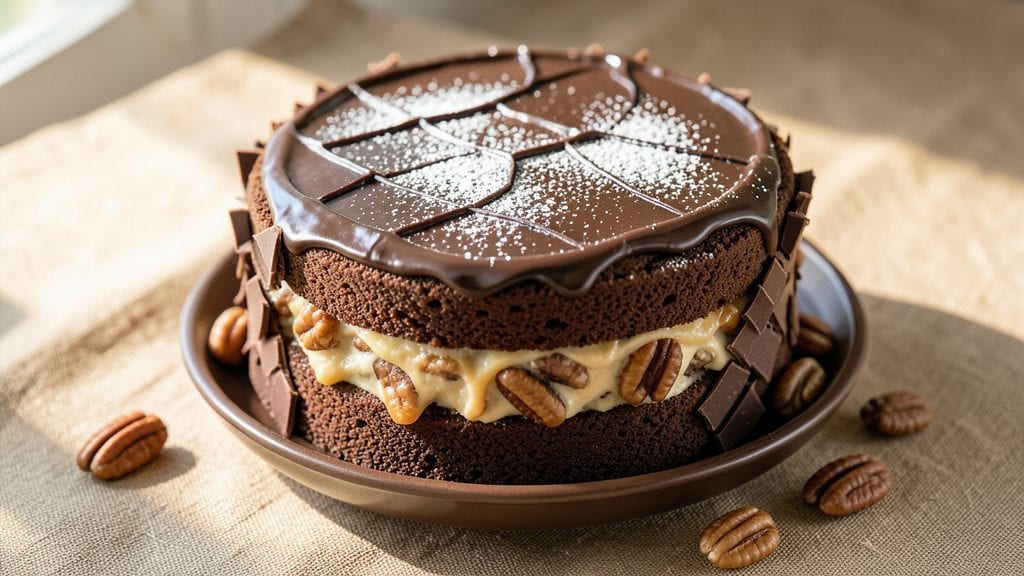
This baker’s German chocolate cake high-altitude recipe ensures foolproof success—moist layers, perfect swirls, and no separation, even at elevations over 3,500 feet. The key adjustments (extra flour, reduced leavening, and precise baking times) transform a risky experiment into a foolproof dessert every time. ✨
This recipe builds on the classic Baker’s German Chocolate Cake but adapts it for elevations above 3,500 feet, where thin layers and dry crumbs are common pitfalls.
The secret lies in balancing moisture with structure—using extra flour to bind while keeping the texture tender, and adjusting baking times to prevent over-rising. The result? Rich, fudgy layers with those signature pecan-coconut swirls that stay intact.
What sets this apart is the ganache frosting, which stays glossy and stable at high altitudes, avoiding the common issue of grainy or separated fillings. The cake’s golden-brown crust gives way to a moist interior, while the pecan-coconut filling adds a nutty-sweet contrast that’s impossible to resist.
Ready in about 1 hour and 30 minutes, it’s perfect for celebrations or satisfying cravings without the altitude headaches.
Whether you’re baking at 5,000 feet or higher, this recipe delivers restaurant-quality results with minimal fuss. The adjustments ensure your cake rises properly, stays moist, and holds its shape—no matter where you live. Let’s get baking!
Ingredients for baker's german chocolate cake high altitude
Precision ingredients ensure altitude-proofed German chocolate cake with perfect swirls and no separation.
| Ingredient | Amount | Notes |
|---|---|---|
| All-Purpose Flour 🌾 | 3 ½ cups | Sifted for aeration, high-protein preferred |
| Unsalted Butter 🧈 | 2 cups | Cold, cubed for creaming |
| Granulated Sugar 🍚 | 2 ½ cups | Superfine preferred for smoothness |
| Dark Brown Sugar 🍚 | 1 ½ cups | Packed firmly for accuracy |
| Large Eggs 🥚 | 4 whole | Room temperature for even baking |
| Baking Cocoa Powder 🍫 | ¾ cup | Dutch-processed for rich flavor |
| Baking Powder 🧂 | 1 ½ tsp | Double-acting for high altitude |
| Salt 🧂 | ¾ tsp | Diamond Crystal preferred |
| Milk 🥛 | 1 cup | Whole milk for moisture |
| Vanilla Extract 🌿 | 2 tsp | Pure Madagascar bourbon |
| Toasted Pecans 🥜 | 2 cups | Chopped, lightly toasted |
| Sweetened Flaked Coconut 🥥 | 1 ½ cups | Toasted for enhanced flavor |
| Semisweet Chocolate Chips 🍫 | 1 ½ cups | High-quality, 60% cacao |
| Heavy Cream 🥛 | 1 ½ cups | Cold for stable ganache |
| Pillowy White Chocolate Chips 🍫 | 1 cup | For ganache richness |
The flour quantity is critical at high altitudes—3.5 cups provides the structural integrity needed to prevent collapse while maintaining moisture. King Arthur or Bob's Red Mill brands are ideal due to their high protein content, which helps bind the cake's structure. For cocoa powder, Dutch-processed brands like Valrhona or Callebaut deliver a smoother, richer flavor without bitterness. The brown sugar must be packed firmly to avoid under-sweetening, and superfine sugar ensures a silky texture. Eggs at room temperature incorporate air more evenly, preventing dense layers. Butter should be cold when creamed to trap air properly, but not rock-hard—softened slightly for easier mixing.
No Dutch-processed cocoa? Natural cocoa works in a pinch, but reduce by 0.25 cup to avoid over-darkening. Pecans can be substituted with walnuts or hazelnuts, though texture differs slightly. Sweetened coconut unavailable? Unsweetened plus 1 tbsp sugar mimics the sweetness. For the ganache, dark chocolate chips can replace white chocolate if preferred, though the flavor profile shifts. Heavy cream must be cold—room temperature cream creates a grainy ganache. Vanilla extract substitutes: 1 tsp imitation (less ideal) or 1 tbsp vanilla sugar (homemade preferred). Butter alternatives: European-style butter has higher fat content for better flavor, while vegetable shortening can replace butter in a 1:1 ratio if needed for altitude stability.
Store dry ingredients (flour, sugar, cocoa) in airtight containers away from heat for up to 6 months. Butter and eggs should be refrigerated until use, with eggs brought to room temperature 30 minutes before mixing. Toasted pecans and coconut retain flavor best in the freezer for 3 months—portion before freezing to avoid clumping. Ganache components (cream, chocolate) keep 1 week refrigerated or 3 months frozen. Assembled cake stays fresh 3 days at room temperature or 1 week refrigerated, though freezing the layers (without frosting) extends shelf life to 2 months. Reheat slices at 250°F for 10 minutes to restore moisture.
Why You'll Love This Recipe
- No Fuss Mixing: I swear by this recipe because it’s one bowl—no fussing with multiple pans or tricky techniques. Cream butter, sugar, and eggs together, fold in the dry ingredients, and you’re done. The high-altitude tweaks (like extra flour and slightly less liquid) mean no dry cake surprises.
- Rich Without the Work: That dark brown sugar and melted butter combo? It’s like a hug in cake form. The molasses depth from the brown sugar pairs perfectly with the buttery richness, and honestly, the chocolate frosting ties it all together without needing fancy ingredients.
- Leftovers That Last: This cake stays moist for days—no sad, crumbly edges here. I’ve sent slices to work lunches, packed them for road trips, and even frozen portions for lazy mornings. The frosting actually improves overnight, so leftovers feel like a treat.
- Budget-Friendly Luxury: I use store-brand butter and basic flour, but the flavor? Feels like a bakery cake. The secret’s in the ratio of sugars—granulated for structure, brown for depth—and the eggs binding it all together. It’s my go-to when I want to impress without breaking the bank.
Step-by-step instructions for baker's German chocolate cake high altitude recipe
Mastering high-altitude baking requires precision—here's how to achieve perfect layers without separation.
👨🍳 Step 1: Prepare the Dry Ingredients with Precision
In a medium bowl, whisk together the 3.5 cups sifted all-purpose flour, 0.75 cup baking cocoa powder, 1.5 tsp baking powder, and 0.75 tsp salt. I sift the flour twice to ensure maximum aeration—this is critical at high altitudes where cakes often collapse. Use a whisk to break up any cocoa lumps completely, creating a smooth, fine powder. Set this mixture aside while you prepare the wet ingredients.
This pre-sifting step eliminates air pockets that could cause uneven baking. At elevations above 5,000 feet, flour absorbs more moisture and expands differently, so thorough mixing here prevents potential separation later. Keep the bowl nearby—you'll need it in the next step.
🍳 Step 2: Cream Butter and Sugars for Maximum Volume
In a stand mixer fitted with the paddle attachment, beat the 2 cups cold cubed unsalted butter on medium speed until completely smooth, about 2 minutes. Add the 2.5 cups granulated sugar and 1.5 cups packed dark brown sugar, then increase speed to high and cream for 4-5 minutes until light and fluffy.
You're aiming for a pale, ribbon-like consistency that nearly doubles in volume. The butter should leave clean streaks when the paddle lifts. This thorough creaming incorporates air that compensates for the reduced atmospheric pressure at altitude. If your mixer struggles with the cold butter, let it sit at room temperature for 10 minutes before starting—just don't let it get too soft.
👨🍳 Step 3: Add Eggs and Liquid Ingredients Gradually
Add the 4 room-temperature large eggs one at a time, mixing well after each addition. Scrape down the sides of the bowl to ensure even incorporation. Next, mix in the 1 cup milk and 2 tsp vanilla extract on low speed until just combined—don't overmix or you'll develop gluten that makes the cake dense.
With the mixer running on low, gradually add the dry ingredients in three additions, mixing just until each is incorporated. This gentle folding maintains the air you worked so hard to create. The batter should be thick but pourable—if it's too stiff, add 1-2 tablespoons milk to adjust. High-altitude batters benefit from this careful layering technique to prevent settling during baking.
🥘 Step 4: Fold in Pecans and Chocolate for Signature Texture
Using a spatula, gently fold in the 2 cups toasted pecans, 1.5 cups sweetened flaked coconut, and 1.5 cups semisweet chocolate chips. Work quickly but carefully to avoid deflating the batter. The pecans should be evenly distributed throughout—don't worry if some chocolate chips remain slightly clustered, as they'll melt beautifully during baking.
This is where the cake's signature texture comes together. The toasted pecans add crunch, while the chocolate creates pockets of rich flavor. For best results, toast your pecans and coconut separately in a dry skillet over medium heat for 3-4 minutes, stirring constantly until fragrant. Let them cool completely before folding into the batter to prevent steam from developing and causing separation.
🔥 Step 5: Bake with Altitude Adjustments for Perfect Layers
Preheat your oven to 350°F (use an oven thermometer to confirm accuracy—high-altitude ovens often run hot). Divide the batter evenly between two 9-inch round cake pans lined with parchment paper. Bake for 25-30 minutes, rotating the pans halfway through, until a toothpick inserted in the center comes out with moist crumbs but no wet batter.
High-altitude cakes bake faster, so watch closely after 20 minutes. The edges should be golden brown while the center remains slightly springy to the touch. If the tops brown too quickly, tent loosely with foil after 15 minutes. Let the cakes cool in the pans for 10 minutes, then transfer to a wire rack to cool completely before assembling.
🍽️ Step 6: Prepare and Assemble the German Chocolate Ganache
In a saucepan, combine 1.5 cups heavy cream and 1 cup pillowy white chocolate chips. Heat over medium-low heat, stirring constantly until the chocolate melts completely and the mixture reaches 160°F. Remove from heat and let steep for 5 minutes to thicken slightly.
This ganache should be smooth and glossy with a pudding-like consistency—thick enough to pipe but still pourable. If it's too thin, chill for 10 minutes to set up. For the filling, spread half the ganache evenly over the first cooled cake layer. Then pipe the remaining ganache around the edges before adding the second layer, allowing some to drip down the sides for that classic German chocolate look.
⏰ Step 7: Chill and Serve for Maximum Moisture
Refrigerate the assembled cake for at least 4 hours, preferably overnight. This chilling time allows the ganache to set properly and prevents the layers from separating. When ready to serve, dust the top and sides with powdered sugar and garnish with additional toasted pecans and coconut flakes.
The cake should be moist with tender crumb and rich chocolate flavor in every bite. High-altitude adjustments ensure the layers hold together beautifully without the common issues of doming or cracking. Serve at room temperature for the best texture contrast between the warm cake and cool ganache.
Pro Tips For Making Baker'S German Chocolate Cake High Altitude
- Reduce Butter First: Melt your unsalted butter slowly in the microwave—30-second bursts—until it’s just liquid but not foamy. I learned this the hard way: over-melting makes the cake dense, and high altitude already fights you. Let it cool to room temp before mixing, or the eggs will scramble in your batter.
- Sift the Flour Twice: High-altitude air makes flour behave like it’s been sifted once too often. Use a fine-mesh sieve and do it twice—once when measuring, once before folding it into the butter-sugar mix. This keeps the cake tender, not cakey. (Yes, it’s extra work, but your future self will notice.)
- Don’t Overmix the Batter: Once you add the eggs, mix just until combined—no streaks, but no arm workout either. Overmixing traps air that’ll expand into tunnels in your cake at altitude. Fold in the chocolate and nuts gently with a spatula; rough handling = sad texture.
- Bake with a Pan Lid: Cover your cake pans with foil loosely (like a tent) for the first 20 minutes. High altitude dries things out fast, and this keeps the top from cracking before it sets. After 20 minutes, uncover and bake until a toothpick comes out mostly clean—it’ll firm up as it cools.
Pro cooking tips for perfect results
Altitude-Proofing Techniques
High-altitude baking demands extra flour—I use 3.5 cups instead of the standard 2.5 cups to compensate for reduced air pressure. This prevents collapse while maintaining moisture.
The baking powder is doubled to 1.5 tsp for proper rise, and I always check my oven thermometer—altitude ovens often run 25°F hotter than expected. 🌡️
Batter Consistency Secrets
For high-altitude success, your batter should be thicker than usual—almost like pudding. If it's too thin, add 1-2 tablespoons extra flour or reduce milk by 1 tablespoon. I test consistency by lifting the spatula: if the batter holds a peak for 10 seconds, it's perfect.
Overmixing develops gluten, so mix just until combined after adding dry ingredients.
Pecan-Coconut Prep Matters
Toast your pecans and coconut separately in a dry skillet for 3-4 minutes until fragrant—this enhances flavor and prevents moisture loss during baking. Let them cool completely before folding into batter to avoid steam pockets that cause separation.
I use a fine-mesh sieve to remove excess coconut flakes if they clump, ensuring even distribution in each slice. 🥜
Ganache Stability Tricks
The ganache is where high-altitude baking can go wrong—it often thickens too fast or separates. I heat the heavy cream to 160°F (not boiling) and let it steep off heat for 5 minutes before using.
For extra stability, I whisk in 1 teaspoon corn syrup to prevent graininess. Chill the ganache for 10 minutes if it's too thin before assembling the cake.
Baking Time Adjustments
High-altitude cakes bake 10-15% faster than sea-level versions. I start checking for doneness at 20 minutes and watch closely after that. The edges should be golden while the center remains slightly springy.
If the top browns too quickly, tent loosely with foil after 15 minutes—this prevents over-browning while allowing steam to escape. 🔥
Cooling and Chilling Strategy
Never rush cooling! Let cakes rest in pans for 10 minutes, then transfer to a wire rack to cool completely. For assembly, I refrigerate the cake for 4 hours (overnight is ideal) to let the ganache set properly.
This prevents the classic high-altitude issue of soggy layers. Dust with powdered sugar just before serving to keep the ganache glossy and prevent sticking.
Nutrition facts
Frequently asked questions
Why does this German chocolate cake recipe need extra flour for high altitude?
At elevations above 3,500 feet, air pressure decreases, causing cakes to rise too quickly and then collapse. The 3.5 cups flour adds structural support while maintaining moisture—standard recipes use only 2.5 cups. This adjustment prevents the classic "doming" effect while keeping the crumb tender. Think of it as reinforcing the cake's skeleton to handle the thinner air.
Can I substitute Dutch-processed cocoa with natural cocoa in this recipe?
Yes, but reduce the amount by 0.25 cup—natural cocoa is more bitter and can darken the cake excessively. For best results, use 0.5 cup natural cocoa instead of the 0.75 cup Dutch-processed called for. The flavor will shift slightly, but the texture remains stable. Always sift cocoa thoroughly to prevent lumps that can cause uneven baking.
What's the best way to tell when the cake is fully baked at high altitude?
Check for doneness at 20 minutes—insert a toothpick into the center. It should come out with moist crumbs but no wet batter. The edges should be golden brown while the center remains slightly springy. High-altitude cakes bake 10-15% faster than sea-level versions, so avoid overbaking. If the top browns too quickly, tent loosely with foil after 15 minutes.
Why does the ganache sometimes separate or become grainy at high altitude?
Thinner air affects the cream's ability to emulsify properly. To prevent separation, heat the heavy cream to exactly 160°F (not boiling) and let it steep off heat for 5 minutes before mixing with chocolate. For extra stability, whisk in 1 tsp corn syrup. If the ganache thickens too fast, chill it for 10 minutes before assembling. This ensures a smooth, glossy finish every time.
How long can I store the assembled cake at high altitude?
Store the cake in an airtight container at room temperature for up to 3 days or refrigerate for 1 week. For longer storage, freeze the layers (without frosting) for up to 2 months. To serve, let it sit at room temperature for 30 minutes to restore moisture. High-altitude cakes dry out faster, so refrigeration extends freshness while preventing the ganache from melting too quickly.